

Capybara fact sheet (free printable)
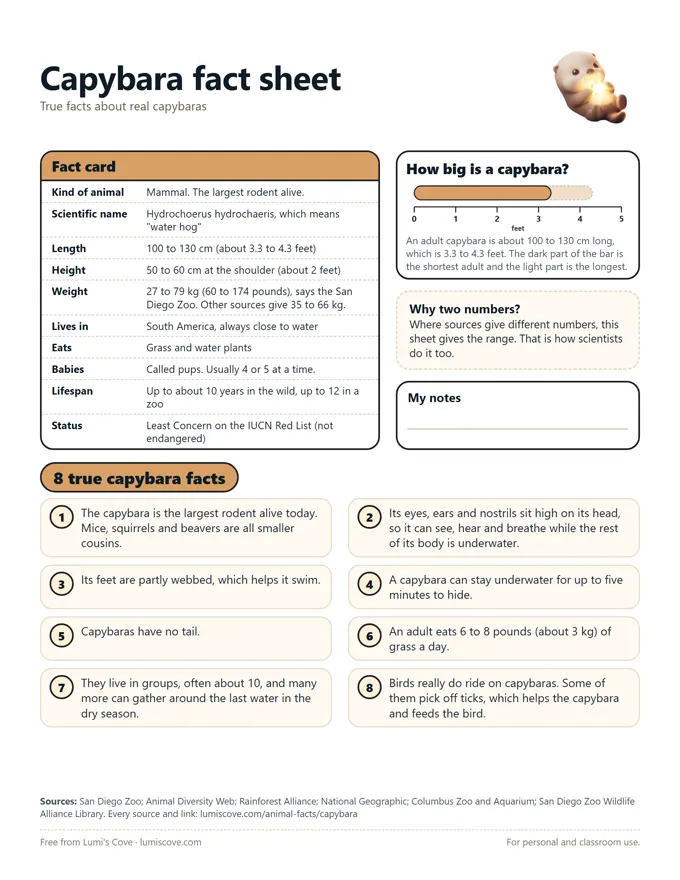
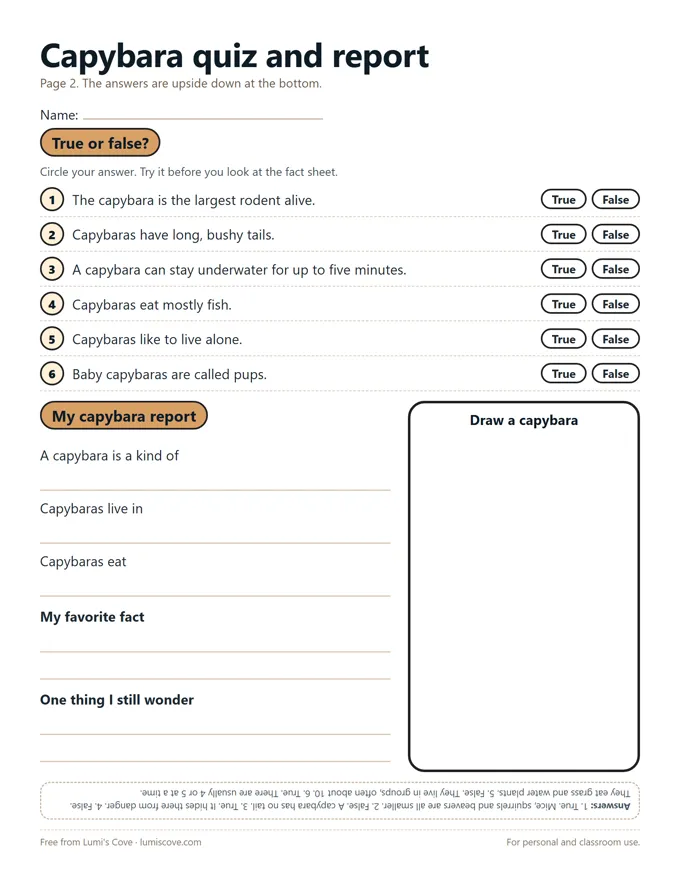
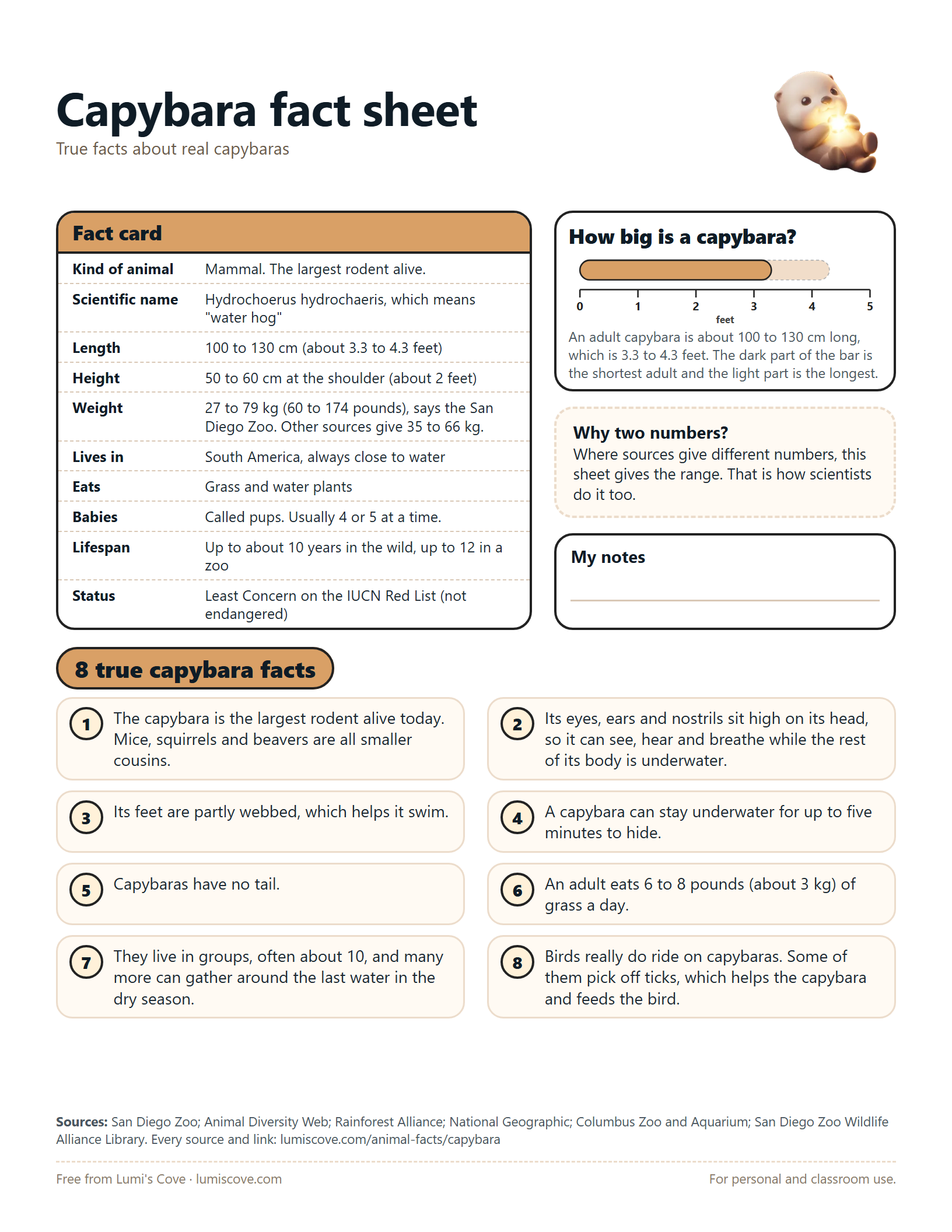
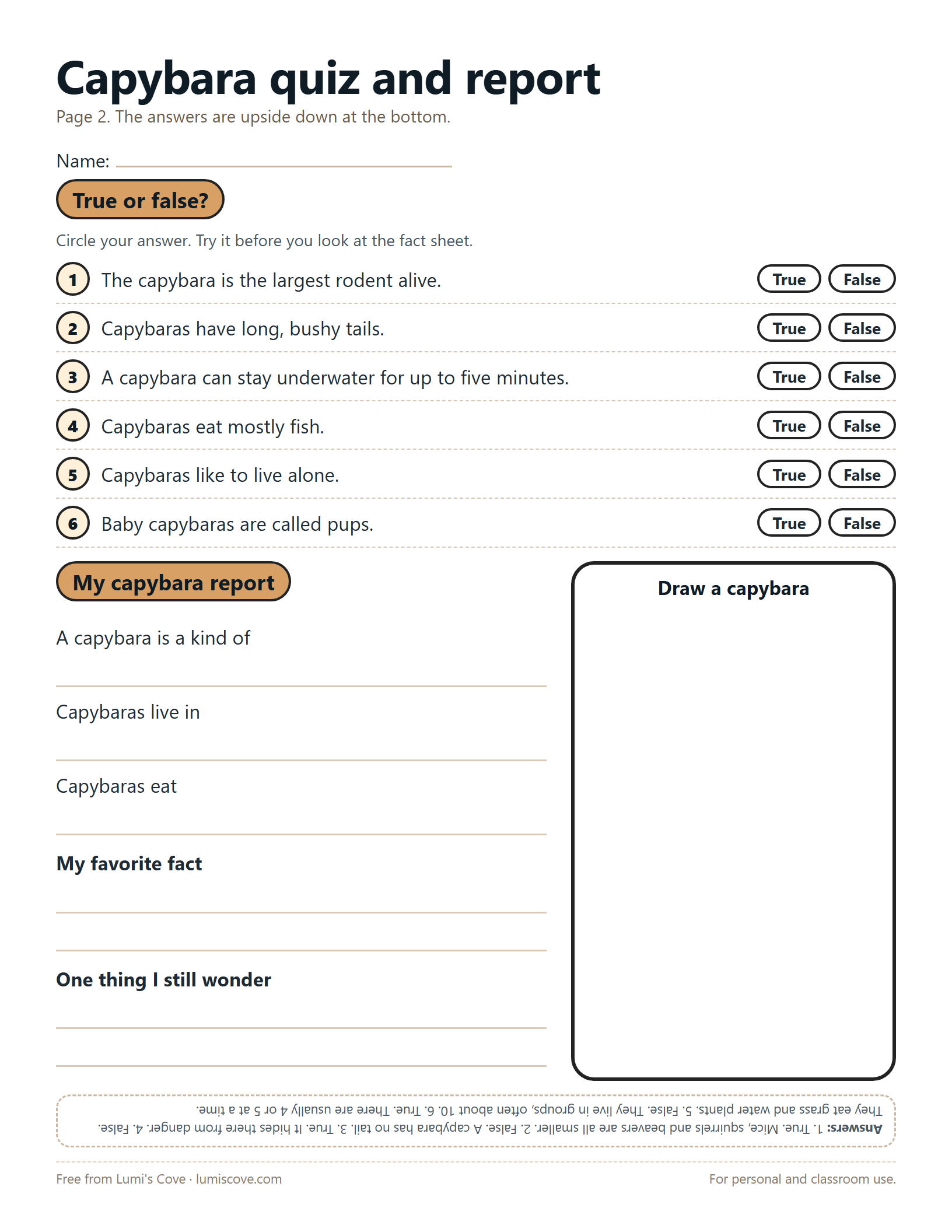
A two-page capybara fact sheet you can print for a school report, a homeschool unit or just for fun. Page 1 has a fact card, a ruler that shows how big a capybara is, and eight true facts. Page 2 has a true-or-false quiz, three sentences to finish and a box to draw in. Every fact comes from the sources listed on our capybara facts page.
Download and print
Two US Letter pages: the fact sheet, then the quiz and report page. Print one or both, in color or black and white.
Save to Pinterest so you can find it again.
For parents: no ads, no chat, no accounts, nothing to buy. Kids never type anything here. Our note for parents
How to use it
- Print page 1 and read it together, or let your child read it alone.
- Print page 2. Circle True or False for each line without peeking at page 1.
- Check the answers. They are printed upside down at the bottom of page 2.
- Finish the three sentences, write down a favorite fact and draw a capybara in the box.
Tips
- Capybaras are a favorite for animal reports right now, so this one gets printed a lot for second to fifth grade.
- For a longer report, ask one more question of your own and look for the answer on the full facts page.
- Teachers: the sheet names its sources (San Diego Zoo, Animal Diversity Web, Rainforest Alliance and others), and the facts page links to every one.
Try the quiz right here
The same six questions are on page 2 of the PDF. Guess first, then tap a question to see the answer.
1 True or false? The capybara is the largest rodent alive.
True. Mice, squirrels and beavers are all smaller.
2 True or false? Capybaras have long, bushy tails.
False. A capybara has no tail.
3 True or false? A capybara can stay underwater for up to five minutes.
True. It hides there from danger.
4 True or false? Capybaras eat mostly fish.
False. They eat grass and water plants.
5 True or false? Capybaras like to live alone.
False. They live in groups, often about 10.
6 True or false? Baby capybaras are called pups.
True. There are usually 4 or 5 at a time.
The eight facts on the sheet
- The capybara is the largest rodent alive today. Mice, squirrels and beavers are all smaller cousins.
- Its eyes, ears and nostrils sit high on its head, so it can see, hear and breathe while the rest of its body is underwater.
- Its feet are partly webbed, which helps it swim.
- A capybara can stay underwater for up to five minutes to hide.
- Capybaras have no tail.
- An adult eats 6 to 8 pounds (about 3 kg) of grass a day.
- They live in groups, often about 10, and many more can gather around the last water in the dry season.
- Birds really do ride on capybaras. Some of them pick off ticks, which helps the capybara and feeds the bird.
Want more? The capybara facts page has all 15 facts, the longer story and a link to every source.
Questions
Where do the capybara facts come from?
From San Diego Zoo, Animal Diversity Web, Rainforest Alliance, National Geographic and other zoos, universities and wildlife groups. We read each page ourselves. The full list, with links, is on the capybara facts page.
What grade is this fact sheet for?
About second to fifth grade. Younger kids can do it with a grown-up reading aloud, and older kids can use it as notes for a longer report.
Are capybaras rodents?
Yes. The capybara is the largest rodent alive. It is in the same family as guinea pigs and cavies.
Do capybaras have tails?
No. The San Diego Zoo and the University of Michigan's Animal Diversity Web both describe the capybara as having no tail.
Can I print copies for my class?
Yes. It is free for home, homeschool, classroom and church group use. Please do not sell it.
Read all the capybara factsSee every animal
More like this
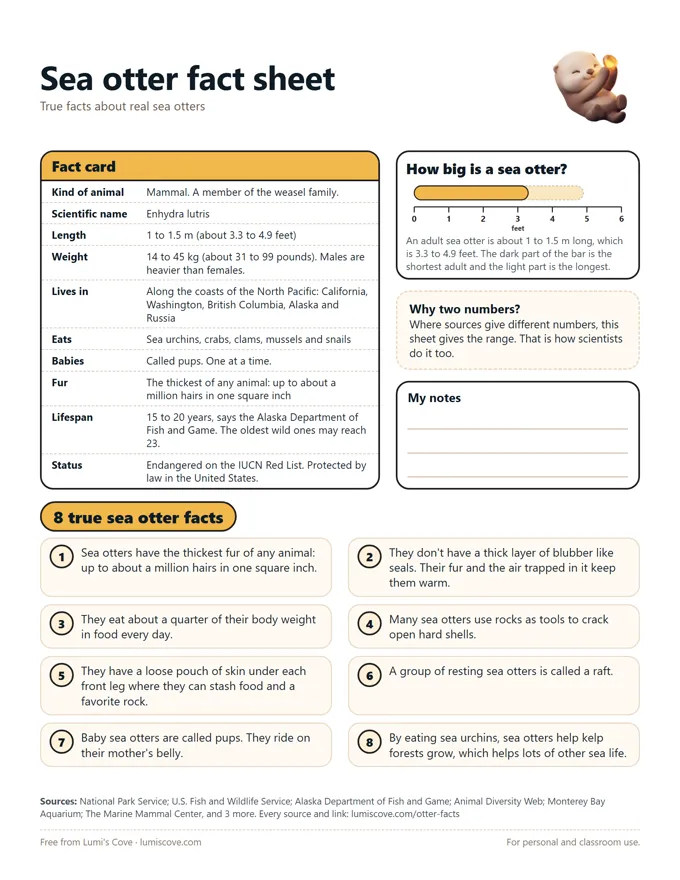 Animal fact sheets
Sea otter fact sheet (free printable)
A fact card, a size ruler and eight true sea otter facts, plus a quiz and report page.
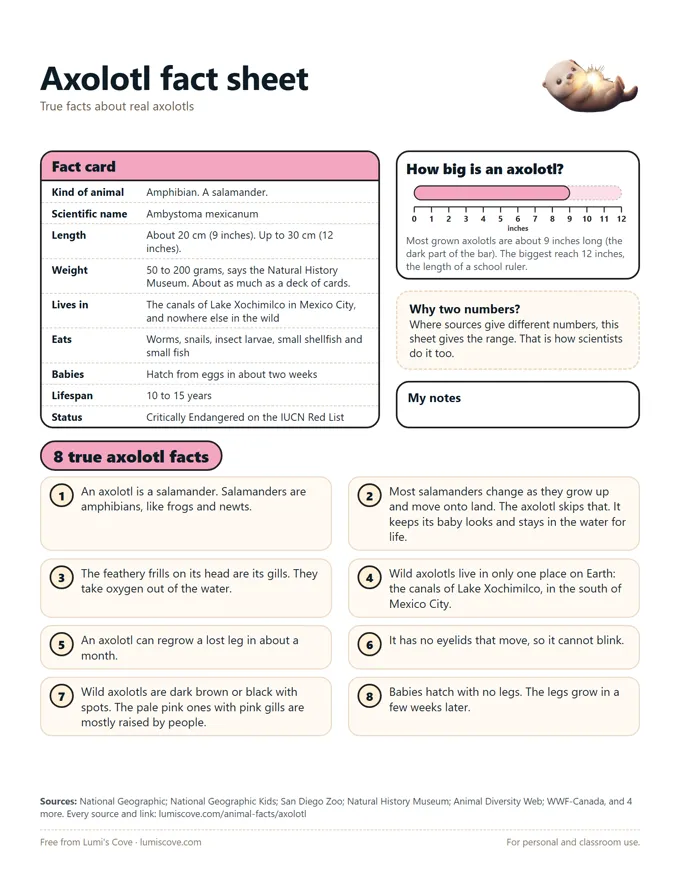 Animal fact sheets
Axolotl fact sheet (free printable)
A fact card, a size ruler and eight true axolotl facts, plus a quiz and report page.
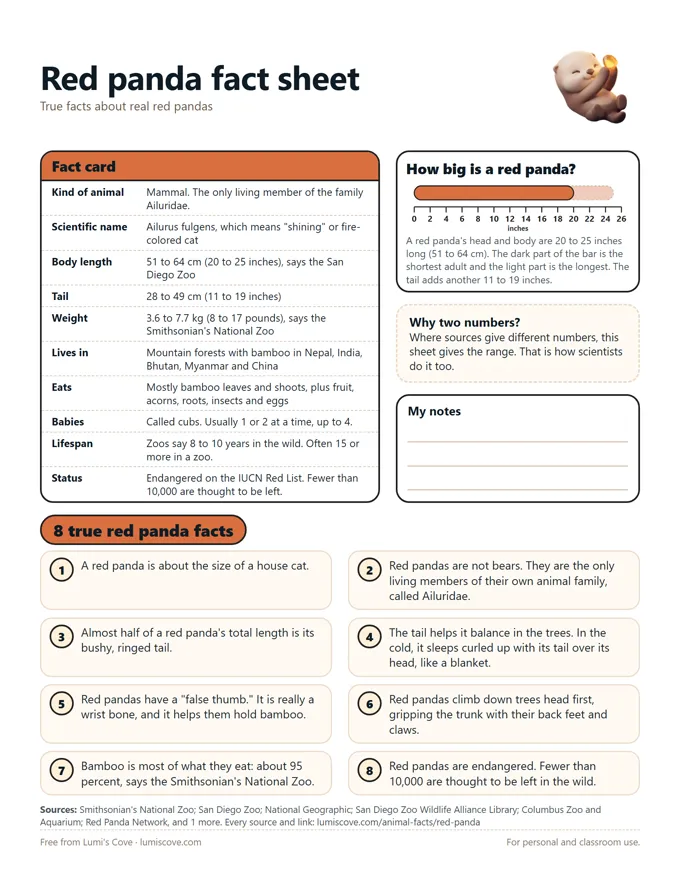 Animal fact sheets
Red panda fact sheet (free printable)
A fact card, a size ruler and eight true red panda facts, plus a quiz and report page.
Get a letter from the cove
One cozy email a week: a new wallpaper or printable, news from Glimmer Cove, and the day each Lumi app comes out. Leave any time.