

The Tide Pools · real animals
Real animal facts
Lumi is a cartoon, but the animals on these pages are real, and the true stories are better than the made-up ones. Each page gives you the short answer first, then the details, then where every fact came from.
6 animals so far
Pick an animal
Start with the fact page, then read the odd questions people ask about each one.
Sea otter facts
Do they hold hands? Why do they have pockets? How do they stay warm with no blubber?
15 facts · 3 questionsCapybara facts
The biggest rodent in the world lives by the water, eats grass and lets birds ride on its back.
15 facts · 3 questionsAxolotl facts
A salamander that never grows up, can regrow a leg, and lives wild in just one place on Earth.
15 facts · 3 questionsRed panda facts
Not a bear and not a raccoon. A cat-sized bamboo eater with a false thumb and a tail it wears like a blanket.
15 facts · 3 questionsPuffin facts
A seabird that flies underwater, carries ten fish at once and raises one fluffy chick called a puffling.
15 facts · 3 questionsRaccoon facts
Front paws like little hands, a black mask, a ringed tail, and a brain that remembers a puzzle for years.
Short answers
Odd questions, true answers
The things people really type into a search box, answered in a few lines with sources.
Why do capybaras like oranges?
Those are yuzu, a citrus fruit, floating in a warm zoo bath in Japan.
Why do capybaras and crocodiles get along?
They are not really friends. Caimans do eat capybaras, mostly the young ones.
Are capybaras friendly?
Friendly with each other, yes. But they are wild animals with sharp teeth.
Do axolotls turn into salamanders?
They already are salamanders. They just skip the change that other salamanders go through.
Why do axolotls smile?
It is just the shape of their mouth. The corners curve up all the time.
Are axolotls endangered?
Yes. Only 50 to 1,000 wild adults are thought to be left, all in Mexico City.
Why do red pandas stand up?
It is not a hello or a hug. Keepers say the red panda is startled and trying to look big.
Are red pandas bears?
No. They have a family all to themselves, and they were called "panda" first.
Are red pandas endangered?
Yes. Fewer than 10,000 are thought to be left, and the number is going down.
Are puffins penguins?
No. Puffins live in the north and can fly. Penguins live in the south and cannot.
Do puffins mate for life?
Mostly. Pairs often stay together for many years and come back to the same burrow.
Do puffins shed their beaks?
Not the whole beak. Just the bright outer plates, after nesting season.
Why do raccoons wash their food?
They are not cleaning it. They are feeling it with very sensitive paws.
Do raccoons hibernate?
No. They fatten up, sleep in a den for days or weeks, and come out on warm days.
Why do raccoons have masks?
It may cut glare and help them see at night. Nobody has proved it yet.
Do sea otters really hold hands?
Yes, sometimes. Sea otters nap floating on their backs, and to keep from drifting away they often wrap themselves in kelp.
Do sea otters have pockets?
Yes. A sea otter has a loose fold of skin under each front leg that works like a pocket.
How do sea otters stay warm?
With fur. Sea otters have the densest fur of any animal, around 850,000 to one million hairs per square inch.
What do sea otters eat?
Sea otters eat animals from the sea floor: sea urchins, crabs, clams, mussels, snails and more. An adult eats about 20 to 30 percent of its body weight every day.
Free printables
Fact sheets to print
A two-page PDF for each animal: fact card, size ruler, eight true facts, then a quiz and report page. Plus a blank report page for any animal.
 Animal fact sheets
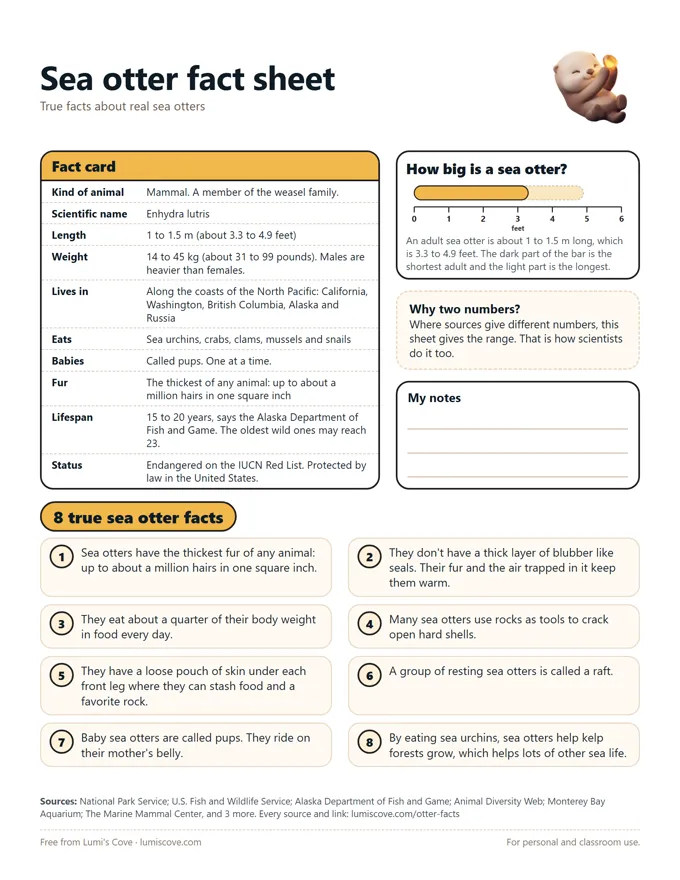
Sea otter fact sheet (free printable)
A fact card, a size ruler and eight true sea otter facts, plus a quiz and report page.
 Animal fact sheets
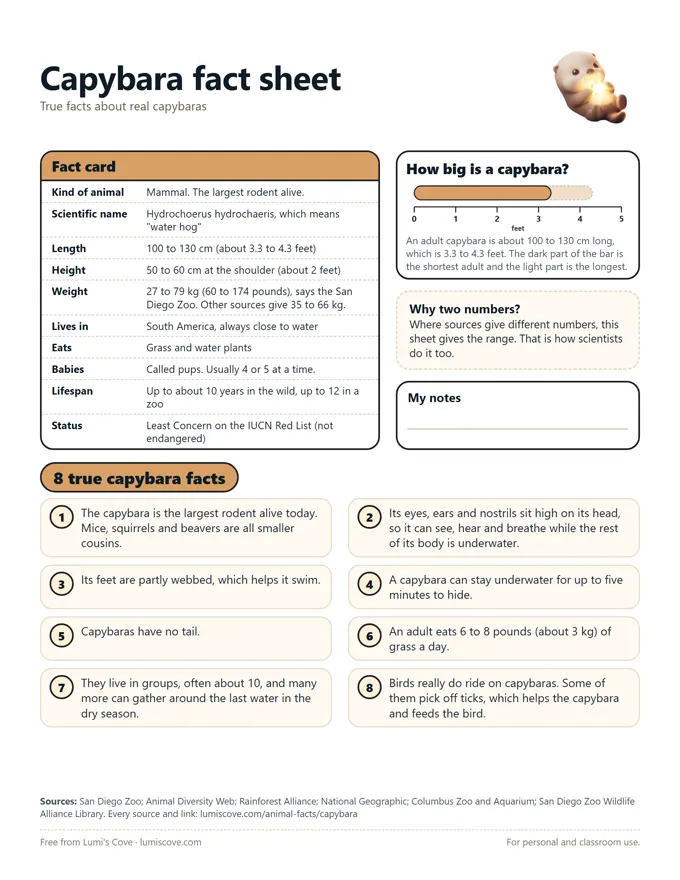
Capybara fact sheet (free printable)
A fact card, a size ruler and eight true capybara facts, plus a quiz and report page.
 Animal fact sheets
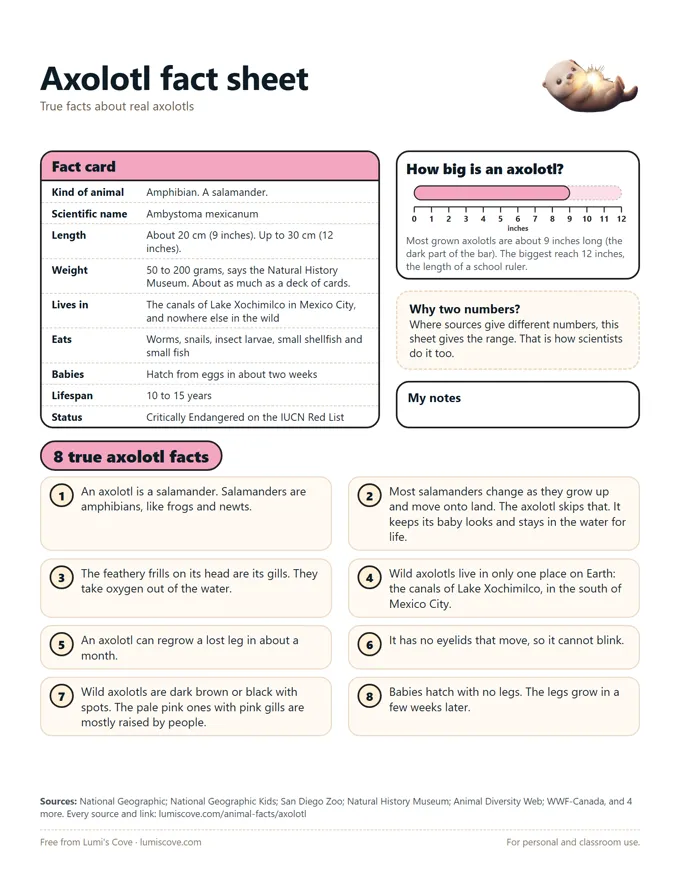
Axolotl fact sheet (free printable)
A fact card, a size ruler and eight true axolotl facts, plus a quiz and report page.
 Animal fact sheets
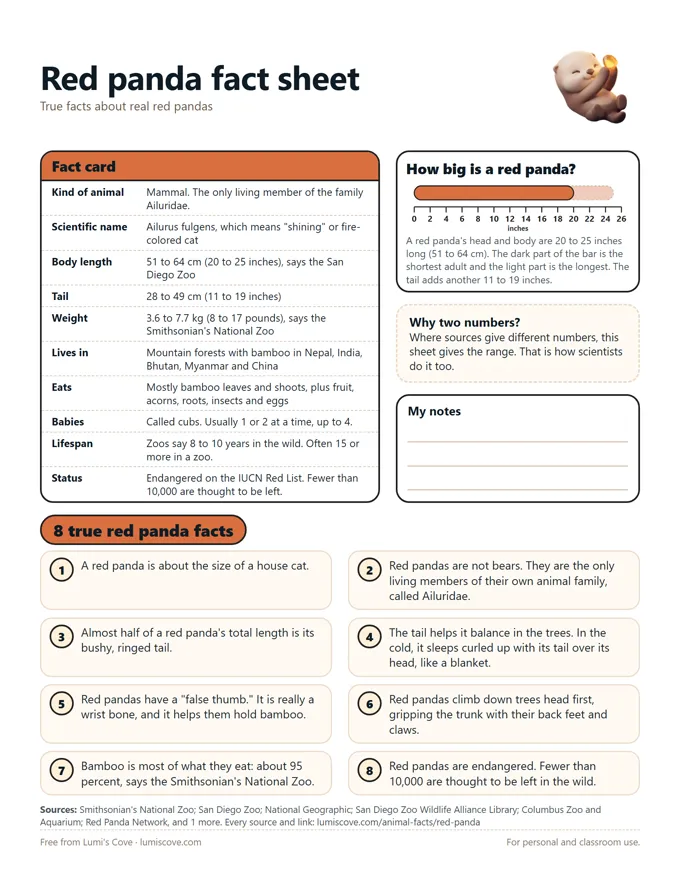
Red panda fact sheet (free printable)
A fact card, a size ruler and eight true red panda facts, plus a quiz and report page.
 Animal fact sheets
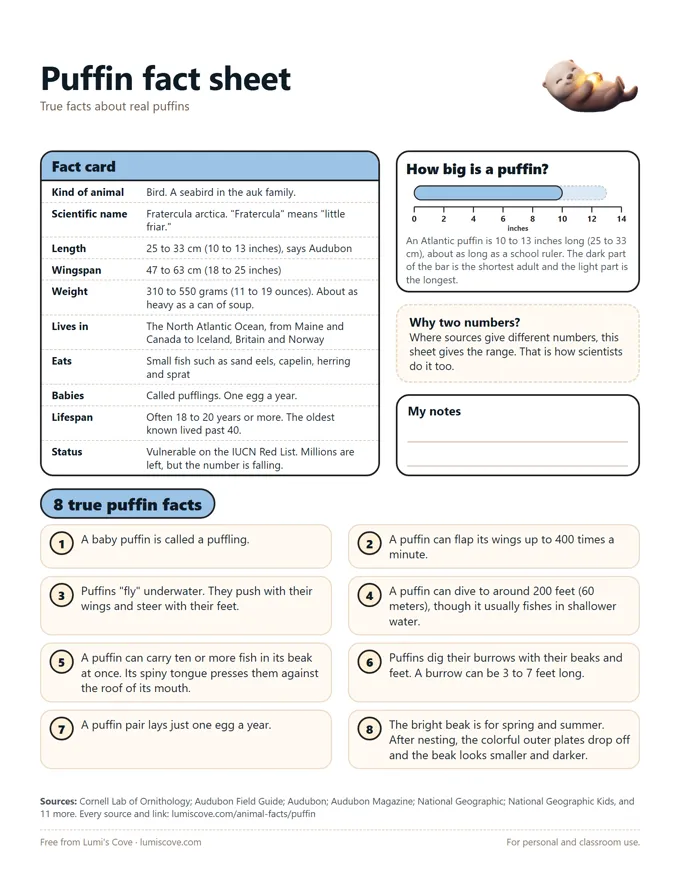
Puffin fact sheet (free printable)
A fact card, a size ruler and eight true puffin facts, plus a quiz and report page.
 Animal fact sheets
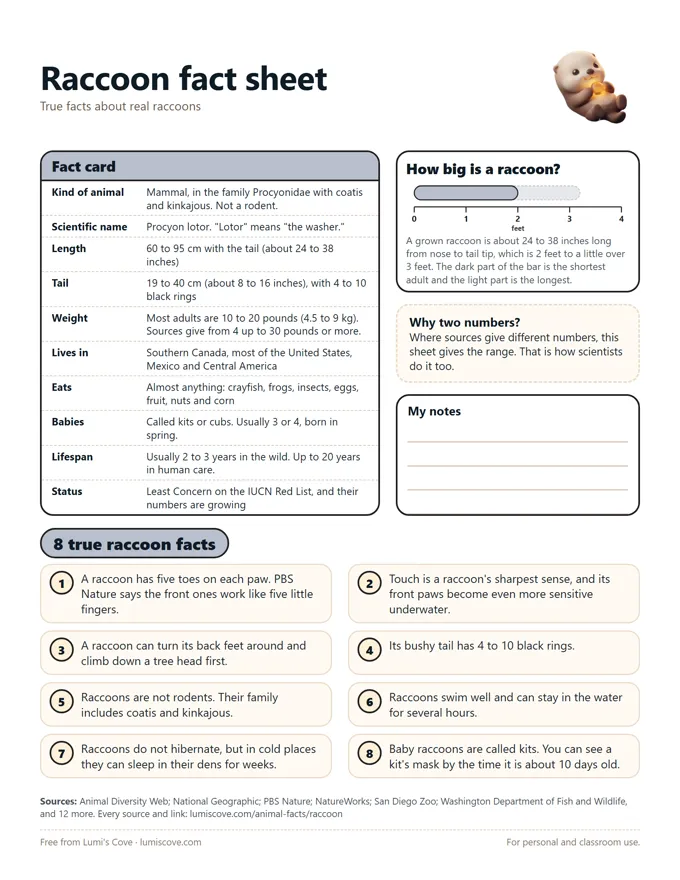
Raccoon fact sheet (free printable)
A fact card, a size ruler and eight true raccoon facts, plus a quiz and report page.
 Animal fact sheets
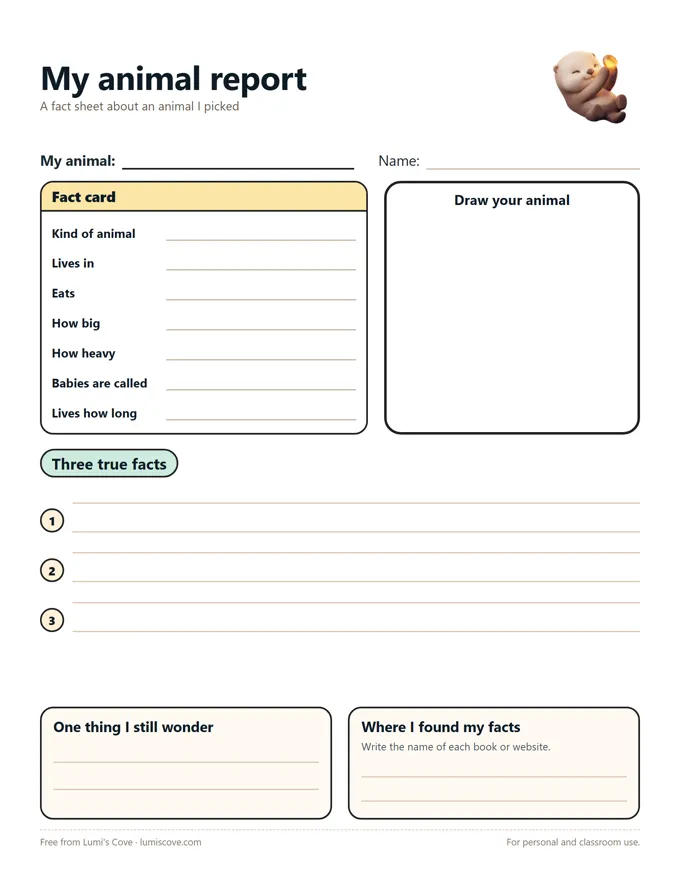
Animal report template (free printable)
A blank fact sheet for any animal: fact card, drawing box, three facts and a sources box.
How we check facts
Lots of animal "facts" get passed around because they are cute, not because they are true. So every page here follows three rules.
- Read the source. A fact goes on a page only when a zoo, aquarium, university, museum or wildlife group says it, on a page we opened and read.
- Say what is not known. If nobody has studied a question, the page says that, and does not guess.
- List every source. The links are at the bottom of each page.
Spot a mistake? Animal science changes. Tell a grown-up to write to us from the about page and we will fix it.
Questions
Where do these animal facts come from?
From zoos, aquariums, universities, museums and wildlife groups. Every page lists the pages we read, so you can check each fact yourself.
Can I use these pages for school?
Yes. They are free to read and print for homework and classrooms. Each page ends with its sources, which is what a teacher will ask for.
What happens when the experts disagree?
We say so. Animal sizes and ages often differ from one source to the next, so those pages give the range and tell you who said what.
Which animals are coming next?
Harbor seals, sea turtles, octopuses and jellyfish are next. After that: bunnies, frogs, ducks, foxes and swans.
Want to color one in? Try the sea otter coloring page.
Get a letter from the cove
One cozy email a week: a new wallpaper or printable, news from Glimmer Cove, and the day each Lumi app comes out. Leave any time.